Meet 3D Sleep™: Better Rest, Now in the Philippines
Loud snoring affects more than your nights. It can change how you feel at work, how patient you are at home, and how well the person beside you sleeps. If you've been looking for a snoring solution or sleep apnea treatment in the Philippines, here's how a custom oral appliance works, who it may suit, and what to expect at each step.
MetroDental now offers 3D Sleep™ oral appliances. For us, it's a natural step. Your mouth, your airway, and your sleep are all part of your overall health.
When Snoring is More Than Noise
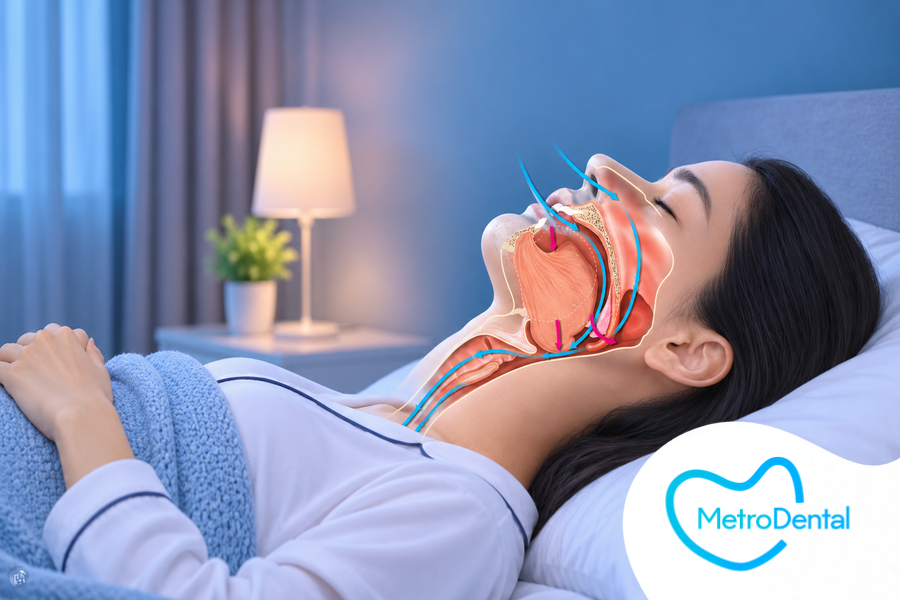
Snoring is common, and on its own it is often harmless. It happens when the soft tissues in your throat relax during sleep and vibrate as air passes through.1
But loud snoring most nights can be a sign of obstructive sleep apnea (OSA), where the airway keeps narrowing or closing during sleep. The short pauses in breathing that follow can break up your sleep, often without you noticing. An estimated 936 million adults worldwide have it.2
Signs Worth Noticing
Quick sleep check – MetroDental
Quick sleep check
Tap any that sound familiar. It takes less than a minute.
Sleeping well
Sounds like you're sleeping fairly well. If anything changes, mention it at your next check-up.
This quick check is not a diagnosis. Only a doctor can diagnose sleep apnea.
Untreated sleep apnea is linked to high blood pressure, heart problems, type 2 diabetes and daytime fatigue.3 The reassuring part is that it can be diagnosed and treated, and there is more than one way to do it.
What is a 3D Sleep™ Oral Appliance?
A 3D Sleep™ oral appliance is a custom-made device you wear over your upper and lower teeth, only while you sleep. It is a type of mandibular advancement device. That simply means it holds your lower jaw (the mandible) slightly forward.
How it works
As you sleep, the muscles in your throat relax and your tongue can fall back, narrowing your airway. By gently holding your lower jaw forward, the appliance helps keep that space open so air can move more freely. For many people, this can reduce snoring and the breathing pauses of OSA. Results vary from person to person, which is why follow-up is part of every plan.
How it's made
Your appliance is designed and made by 3D Sleep™, an Australian dental laboratory that focuses on sleep appliances. We take a digital scan of your teeth and bite, so there's no need for traditional impression trays. The lab uses that scan to design your appliance, then 3D-prints it from medical-grade nylon.4 The forward position can be adjusted over time, so your dentist can fine-tune it.
There is more than one design. Your dentist will recommend one based on your mouth and sleep habits. The appliance is small and fits in a case for travel.
Who Oral Appliance Therapy May Suit?
The American Academy of Sleep Medicine and the American Academy of Dental Sleep Medicine published a clinical practice guideline on oral appliance therapy in 2015. It supports custom, adjustable oral appliances, provided by a qualified dentist, for adults who snore. It also supports them as a treatment option for some adults with OSA. Oral appliances are most often used for mild to moderate OSA.5
Oral appliances are one of several treatment options for sleep apnea. For more severe sleep apnea, a CPAP breathing machine remains the gold-standard treatment, and an oral appliance may be considered, under a sleep physician's guidance, for people who can't use CPAP or would prefer another option. Your sleep physician and your dentist will help you decide what fits you.
Oral appliances generally suit adults with enough healthy teeth to hold them in place and healthy gums. They may not suit you if you have active gum disease, too few teeth, or jaw joint (TMJ) problems that haven't been assessed.
What to Expect at MetroDental, Step by Step
What to expect, step by step – MetroDental
Step 1 of 6
1
We talk about your sleep, your concerns and your goals. We check your teeth, gums, bite and jaw joints.
2
If sleep apnea is suspected, a sleep study and a sleep physician's assessment come first, because only a doctor can diagnose it. We coordinate with sleep physicians and ENT specialists. Depending on your needs, this may be a home sleep test or a study in a sleep lab.
3
If an appliance is right for you, we take a quick, comfortable 3D scan of your teeth and bite.
4
Your scan goes to the 3D Sleep™ laboratory, where your appliance is custom-made. We'll give you a clear timeline.
5
We check the fit and comfort, and show you how to wear and clean your appliance.
6
We adjust the appliance gradually. A follow-up sleep test with your doctor checks how well it's working, and regular dental visits help us look after your teeth and bite.
Most people get used to the appliance within a week or two.4 At first, some feel mild jaw or tooth soreness, extra saliva or a dry mouth. Over time, these side effects usually settle on their own. With long-term use, the bite can shift gradually, which is why we keep seeing you for reviews.
Talk to our dentists
If you snore, wake up tired, or have a partner who's been dropping hints, a consultation is a calm first step. Book a visit at The Podium, Eastwood Mall, TriNoma or Greenbelt 5, and talk to our dentists about whether 3D Sleep™ fits your care plan.
Disclaimer: This article is for general information only and is not a substitute for professional medical or dental advice, diagnosis or treatment. Only a physician can diagnose sleep apnea. 3D Sleep™ and other oral appliances do not replace CPAP for everyone; CPAP remains the gold-standard treatment for sleep apnea. Oral appliances are not suitable for everyone, and individual results vary. If you have concerns about your sleep or breathing, please consult a physician or sleep specialist, and talk to your dentist about whether an oral appliance is right for you.
Benjafield AV, et al. Estimation of the global prevalence and burden of obstructive sleep apnoea: a literature-based analysis. The Lancet Respiratory Medicine. 2019;7(8):687-698. https://doi.org/10.1016/S2213-2600(19)30198-5
Ramar K, et al. Clinical practice guideline for the treatment of obstructive sleep apnea and snoring with oral appliance therapy: an update for 2015. Journal of Clinical Sleep Medicine. 2015;11(7):773-827. https://doi.org/10.5664/jcsm.4858